
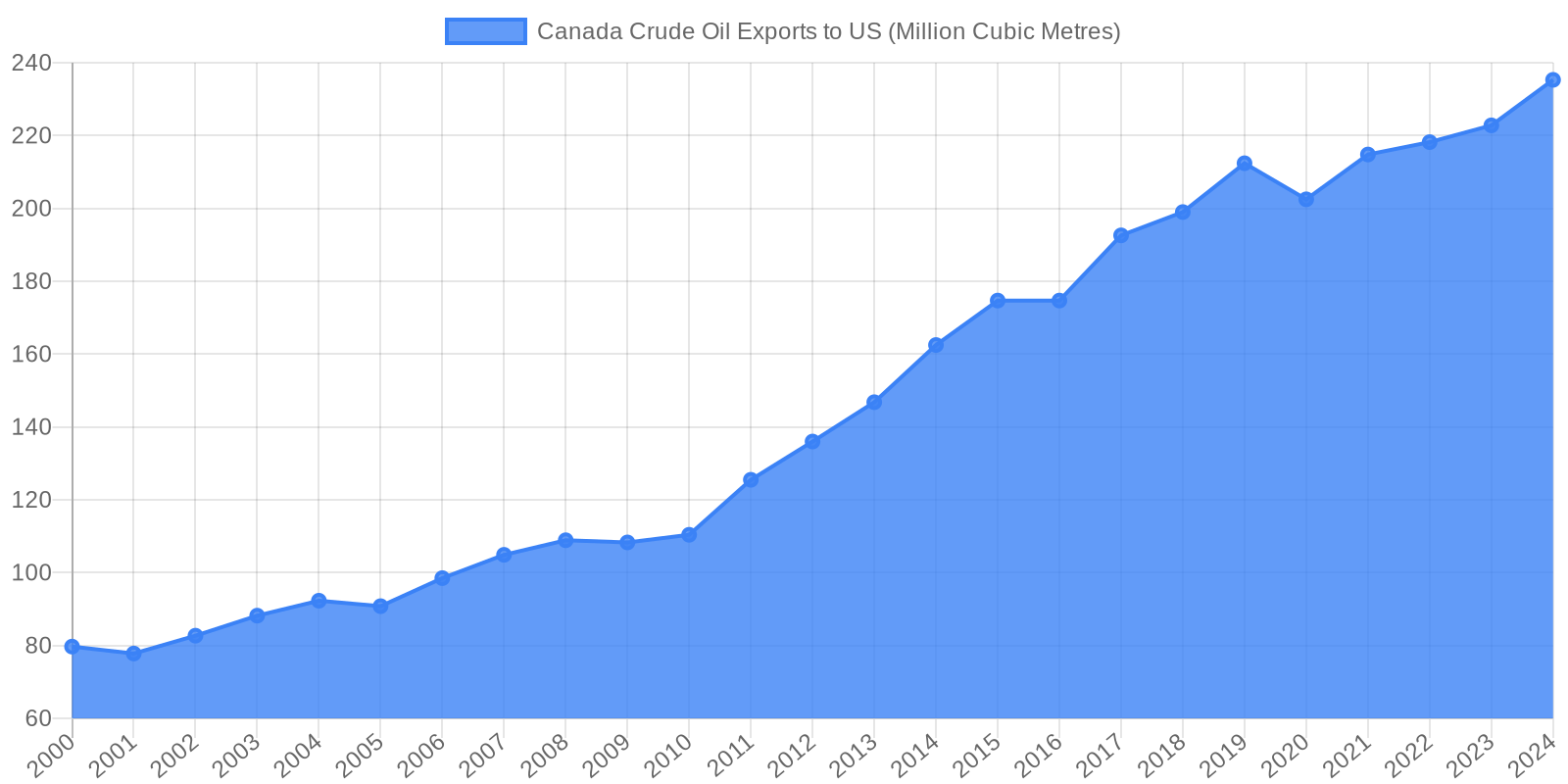
Canada's crude oil exports to the United States have nearly tripled over the past 24 years, growing from 79.7 million cubic metres in 2000 to 235.3 million cubic metres in 2024, underscoring the critical need for expanded pipeline infrastructure capacity.
A new pipeline proposal to transport oil from Canada to Wyoming could potentially utilize idle infrastructure from the cancelled Keystone XL project, offering renewed hope for expanding cross-border energy transportation capacity. According to Financial Post, analysts suggest this proposal could "piggyback off pipe laid" for the project that was terminated in 2021 after President Biden revoked its presidential permit. The development comes as Canada continues to struggle with insufficient pipeline capacity to move its growing crude oil production to key markets, a constraint that has cost the energy sector billions in lost revenues over the past decade.
The Fraser Institute has extensively documented the economic consequences of inadequate pipeline infrastructure. Insufficient pipeline capacity has been a major issue undermining the competitiveness of energy producers in Western Canada, with the lack of adequate capacity meaning that Canadian producers received far less value for their oil than international counterparts—resulting in C$20.6 billion in foregone revenues for the energy industry in 2018 alone. From 2013 to 2017, the depressed price for Canadian heavy crude oil resulted in CA$20.7 billion in foregone revenues, equivalent to almost 1 percent of Canada's national GDP. The institute's research demonstrates how pipeline constraints have forced Canadian oil into oversupplied regional markets, creating price differentials that far exceed normal transportation costs.
The Fraser Institute's analysis reveals that the cancelled Keystone XL project would have created "60,000 direct, indirect and induced employment opportunities" and provided a $3.4 billion boost to U.S. GDP and $2.4 billion to Canada's bottom line. Beyond immediate economic benefits, researchers at the institute have highlighted broader infrastructure implications. The cancellation represents "the death of our advanced democratic society's ability to build the kind of large-scale infrastructure required to maintain its prosperity and quality of life in decades to come." The institute's research shows that pipelines are 2.5 times safer (i.e., less likely to experience an oil spill) than rail transport, contradicting arguments that pipeline opposition serves environmental interests.
Looking forward, the Fraser Institute emphasizes that insufficient pipeline capacity has imposed significant costs on the economy as a whole and will continue to do so, reaffirming Canada's critical need for additional pipeline capacity. With Canadian crude oil exports to the U.S. reaching 235.3 million cubic metres in 2024—nearly triple the volume from two decades earlier—the potential revival of Keystone XL assets through new proposals could help address persistent capacity constraints. The steep price discount for Canadian heavy crude and its associated foregone revenues will remain until new pipeline capacity comes online, with federal and provincial policymakers needing to take concrete action to get pipelines built for the benefit of Canadians and the economy. Any project utilizing existing Keystone XL infrastructure could significantly reduce development costs and timelines compared to entirely new construction.