
A Renfrew Heights property in Vancouver recently sold below its assessed value, advertised as a building lot rather than a livable home. The house had most heritage features removed and required considerable renovations, reflecting a market where even land value no longer guarantees assessed prices. This transaction exemplifies the broader correction sweeping through Greater Vancouver's single-detached home market, where benchmark prices have declined from $2.01 million in early 2025 to $1.908 million by year-end—a drop of more than $100,000 in just twelve months.
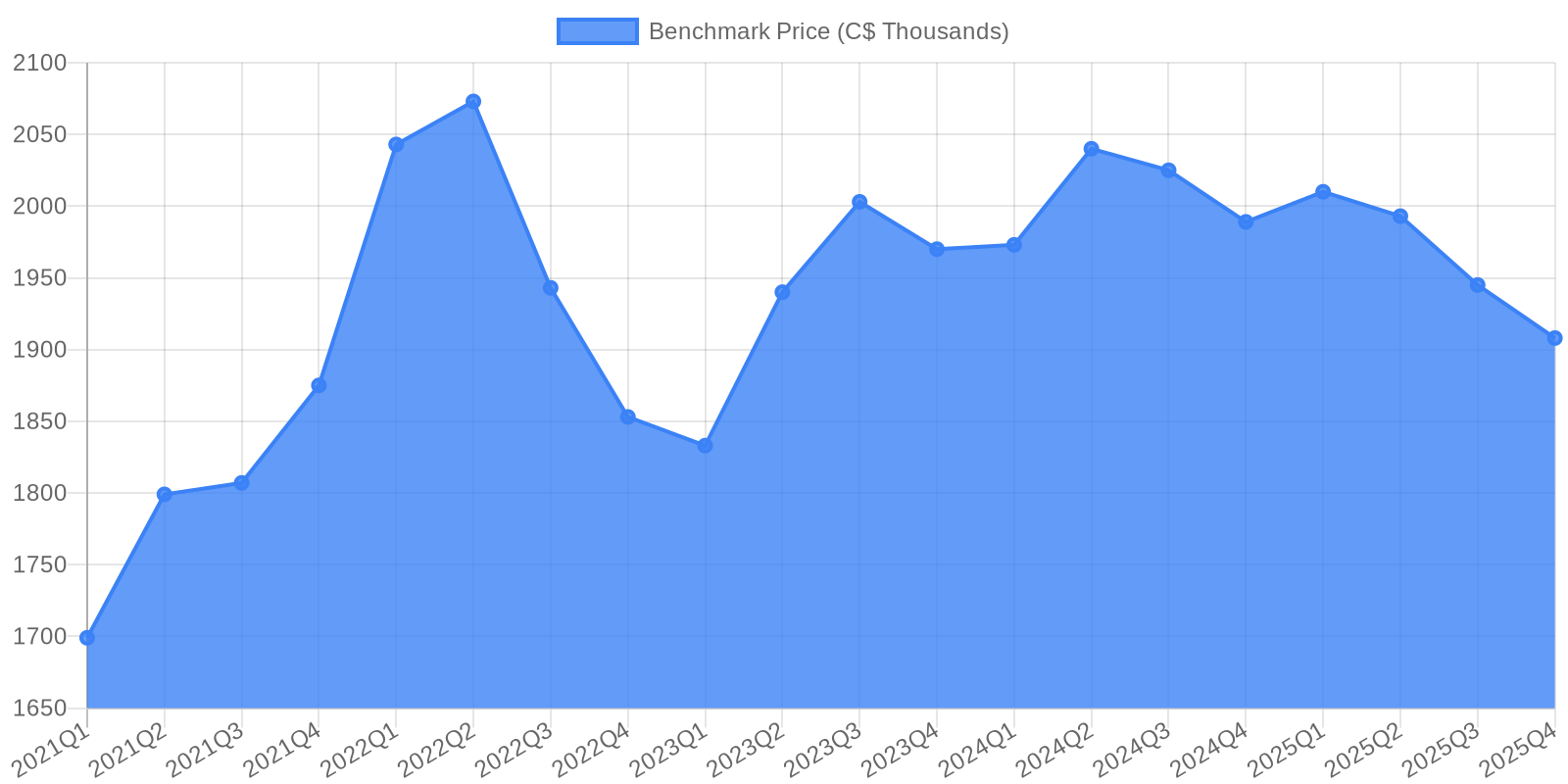
Greater Vancouver single-detached home benchmark prices have fallen $102,000 from early 2025 peaks, breaking through 2024 support levels and continuing a volatile correction that began after the market peaked at $2.073 million in mid-2022.
The sale underscores findings from the Fraser Institute's recent analysis showing that even after prices fell from their $1.25 million peak in mid-2022 to roughly $1.14 million, homes remain unaffordable for most families. In 2023, the annual median after-tax income for a family in Metro Vancouver was $64,660 while the price of a typical home was $1.17 million, meaning a typical family had to save $238,240—equal to more than three-and-a-half years of its after-tax income—for a 20 per cent downpayment. The Renfrew Heights sale signals that properties once viewed as valuable for their land alone now struggle to meet assessments when buyers factor in demolition costs, regulatory hurdles, and construction timelines. Structural market forces—not temporary fluctuations—drive this correction as inventory remains elevated and sales activity hits levels not seen in over two decades.
The chart data reveals the market's volatility since the pandemic boom: prices surged 20% from 2021 to their 2022 peak, then entered a rolling correction punctuated by false recoveries. The current downturn differs from earlier dips because it breaks through the psychological floor established in 2024. Government policies continue to hinder housing development in the province, as many B.C. municipalities increase housing costs by charging high government fees on new developments—in Burnaby, for example, these fees add more than $38,000 to the cost of building an apartment unit and more than $80,000 to the cost of building a single-family home. The Fraser Institute research identifies these regulatory barriers as fundamental obstacles: without reforms that reduce costs and delays for homebuilders, Metro Vancouver's housing crisis will continue. Properties marketed as teardowns face particularly steep headwinds because buyers must navigate lengthy approval processes that can stretch beyond 17 months in some municipalities, plus absorb substantial development charges before construction even begins.
The Renfrew Heights transaction offers a preview of Vancouver's emerging market reality. Sellers who once counted on land value to support prices now confront buyers armed with calculators and caution. Properties needing demolition carry hidden costs that erode whatever premium location might command. The Fraser Institute data makes clear that Vancouver's affordability crisis stems from supply constraints imposed by restrictive zoning, unpredictable approval timelines, and fees that cascade through every stage of development. When a building lot sells below assessment, it signals that even speculators and developers—traditionally the most optimistic market participants—question whether regulatory hurdles and construction costs can be recovered. This shift from irrational exuberance to cold-eyed calculation may finally force the policy reforms that decades of advocacy could not.