
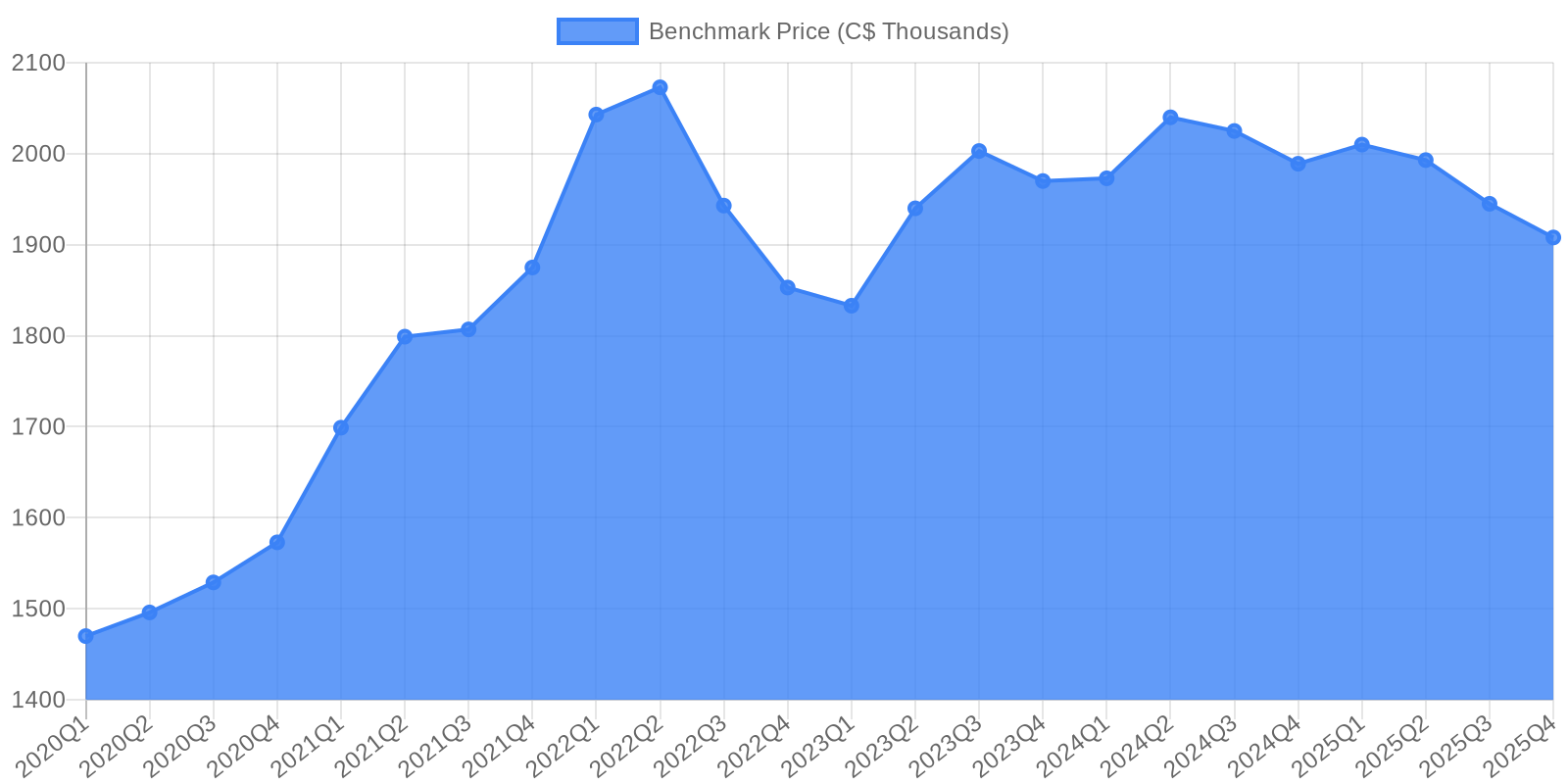
Greater Vancouver single-detached home benchmark prices peaked at $2.07 million in Q2 2022 before declining to $1.91 million by Q4 2025, representing an 8% nominal correction that remains 30% above pre-pandemic levels.
A Vancouver home in Renfrew Heights recently sold below its assessed value despite being marketed as a building lot, with the property having already lost most of its heritage features and requiring considerable renovations. This transaction, reported on February 27, 2026, exemplifies a peculiar moment in Vancouver's housing market where even properties with redevelopment potential struggle to command premium prices, reflecting broader cooling trends that have seen benchmark prices for single-detached homes in Greater Vancouver decline from $2.07 million in early 2022 to $1.91 million by late 2025.
The decline in house prices hasn't been enough to meaningfully improve affordability, yet has made it harder for builders to cover their costs, prompting a steep contraction in homebuilding at a time when the city needs more new homes—an unhealthy dynamic made worse by government policy, according to research from the Fraser Institute. Municipal approvals for new housing projects take twice as long in Vancouver (7.7 months) as they do in Edmonton (3.4 months) or Regina (3.2 months), while new high-rise developments in Vancouver face municipal fees of $30,900 per unit—compared to $9,300 in Edmonton and $9,000 in Regina. These structural barriers help explain why properties marketed as redevelopment opportunities fail to attract buyers willing to pay assessed values when regulatory costs and approval timelines erode profit margins.
The Renfrew Heights sale illustrates a paradox at the heart of Vancouver's housing crisis: falling prices that should theoretically improve affordability instead create conditions that discourage the very construction needed to solve supply shortages. Canadian house price indicators generally reveal that Canadian house prices surged from 2020 to 2022, followed by modest declines in 2023 and 2024 that have left nominal prices near record highs, though when adjusted for headline inflation, real house prices peaked in 2022 before declining towards pre-pandemic levels. The benchmark price data shows this trajectory clearly, with Greater Vancouver single-detached homes peaking at $2.07 million in Q2 2022 before retreating to $1.91 million by Q4 2025—an 8% nominal decline that has paradoxically worsened housing construction economics. Builders would build more homes in Metro Vancouver, despite falling prices, if not for lengthy approval processes and costly government fees, creating a vicious cycle where market corrections fail to deliver either affordability for buyers or viable conditions for developers.
The case of this below-assessment sale reveals how Vancouver's housing market has entered a precarious equilibrium where neither buyers nor builders find favorable conditions, despite years of policy interventions. Canada's housing-affordability crisis mainly reflects demand for housing exceeding the available supply, with Canada experiencing record population growth—driven almost entirely by immigration—with an accompanying increased demand for housing. As the benchmark price chart demonstrates, even the 8% correction from peak levels leaves prices 30% above pre-pandemic levels, ensuring homes remain out of reach for median-income families while simultaneously squeezing developer margins thin enough to discourage new construction. Without reforms that reduce costs and delays for homebuilders, Metro Vancouver's housing crisis will continue, suggesting that transactions like the Renfrew Heights sale—where redevelopment potential fails to command premium pricing—may become increasingly common until fundamental regulatory reforms address the structural barriers that prevent supply from responding to persistent demand.