
President Donald Trump is convening technology executives from Amazon, Google, and Meta at the White House next week to sign pledges committing their companies to cover electricity costs for their expanding data center operations. The initiative represents a strategic pivot as the administration seeks to address mounting concerns about the strain artificial intelligence and cloud computing infrastructure are placing on the nation's power grid. The voluntary commitments aim to shift the financial burden of grid upgrades and power generation away from residential consumers and onto the tech giants whose energy-intensive operations are driving unprecedented demand growth.
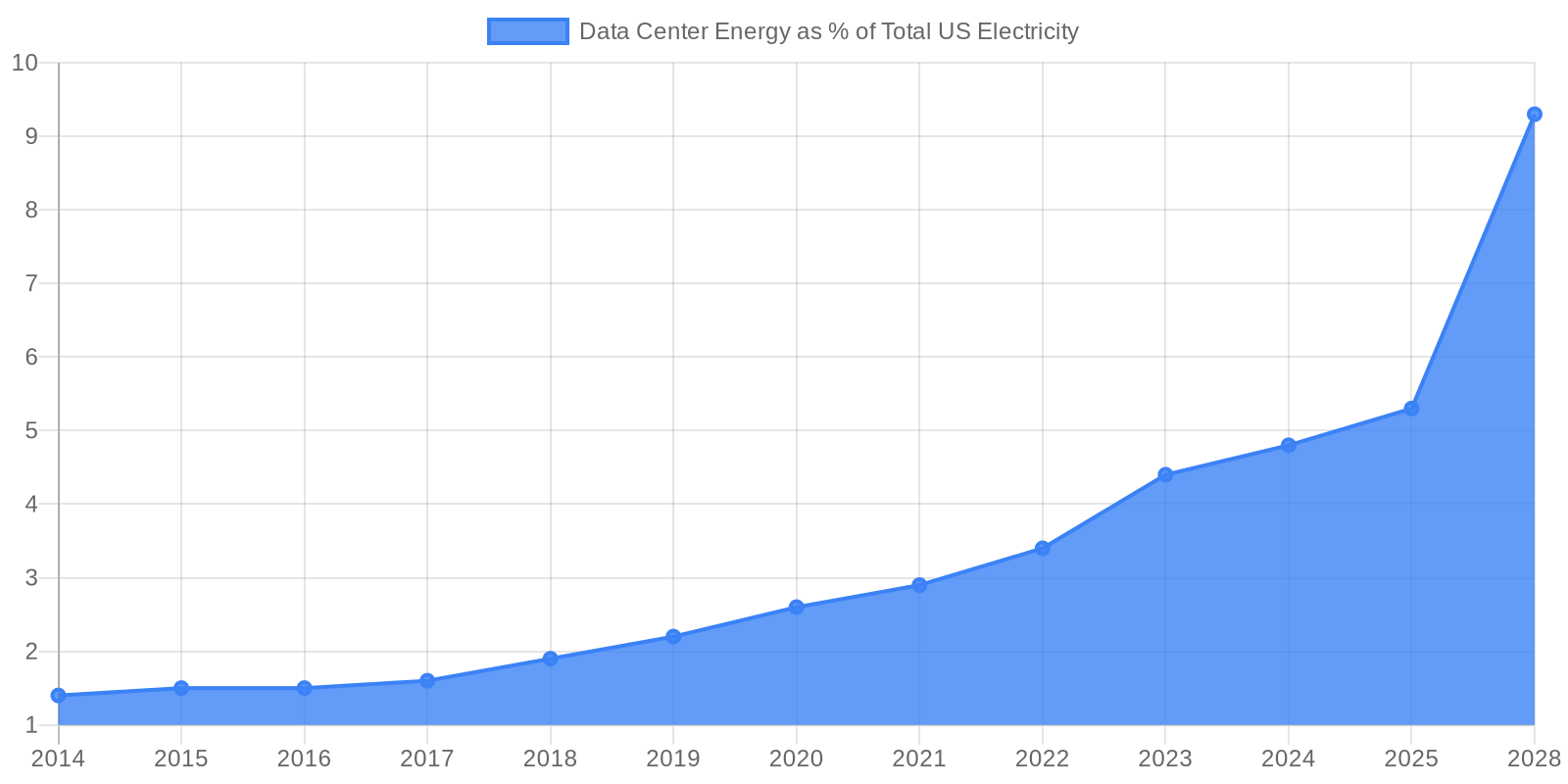
US data center electricity consumption has more than tripled as a share of total electricity from 2014 to 2024, and is projected to nearly double again by 2028, illustrating the accelerating strain on power infrastructure from AI and cloud computing expansion.
The urgency behind Trump's summit reflects a fundamental challenge that transcends political cycles: the physical limitations of energy infrastructure in an era of exponential computational growth. Research from the Fraser Institute examining electricity infrastructure constraints demonstrates that "the slow pace of regulatory approvals, high and rising costs of major energy projects, substantial land requirements, and public opposition to project siting" create formidable obstacles, while "the process of planning and constructing electricity generation facilities" remains "complex and time-consuming, often marked by delays, regulatory hurdles, and significant cost overruns." This analysis, focused on Canadian electricity grid decarbonization, illuminates parallel challenges facing US infrastructure: traditional utility planning operates on decade-long timelines while data center deployment accelerates on quarterly cycles. The mismatch has transformed electricity access from a background assumption into a strategic constraint determining where facilities can be built and which workloads they can support.
The chart data reveals the magnitude of the challenge: data centers consumed just 1.4% of total US electricity in 2014, but that figure has tripled to 4.8% by 2024 and is projected to nearly double again to 9.3% by 2028. According to the US Energy Information Administration, this trajectory represents the fastest-growing segment of electricity demand in two decades. The Fraser Institute's research on Canada's electricity transition notes that "electricity demands are expected to grow in line with the country's population, economic growth, and the transition to electrified transportation," with projections estimating "the need for an additional 684 TWh of generation capacity by 2050." The US faces comparable pressures, but with the added complexity that AI training models and high-performance computing workloads require continuous, ultra-reliable power with minimal interruption—a demand profile fundamentally different from traditional industrial or residential use that can tolerate brief outages or demand management.
The White House initiative attempts to resolve a collision between technological ambition and infrastructure reality that voluntary commitments alone cannot address. Fraser Institute modeling examining grid transformation found that "it is infeasible to rely solely on renewable sources of energy for 100 percent of power generation—the costs are prohibitive," a finding that complicates tech companies' simultaneous commitments to carbon neutrality and massive capacity expansion. While corporate pledges to fund infrastructure may accelerate some projects, they cannot overcome transmission bottlenecks, interconnection queue backlogs averaging 35 months, or the fundamental physics of integrating intermittent renewable generation with baseload-demanding data centers. The real test will be whether this summit catalyzes regulatory reforms enabling faster permitting, co-location of generation with loads, and market mechanisms that reward flexibility—or whether it becomes merely symbolic as grid constraints increasingly dictate which AI ambitions can physically be powered and which remain computationally stranded.